Stop making everything match: a guide to brand coherency

Consistency is about what you say; coherence is about what you do.
What is brand coherence?
Brand coherence is the strategic alignment of a brand’s purpose, messaging, and experience. Unlike rigid consistency, it allows a brand to adapt to new contexts and audiences while remaining true to its core identity.
A drive-through Starbucks in my hometown of Ocala, Florida, is visually and audibly inconsistent with Midtown Manhattan’s multi-kiosk operation. But its core promise of a seasonal Pumpkin Spice Latte carries across markets.
Strict, unchanging rules prevent a brand from adapting to cultural shifts. A coherent brand trusts its people to interpret the brand’s purpose. The goal is participatory and experiential, so we all evolve together.
Coherence vs. Consistency
-
Alignment with core values and purpose, even as expressions adapt.
About what we do; a business-wide principle.
Expressed through purpose, messaging, and experience.
-
Uniformity and repetition of specific brand assets across all channels.
About what we say; a marketing principle.
Expressed through logo-centric brand identities, templates, and style guides.
Characteristics of coherent brands
They have an unchangeable core.
What is the one unfakeable belief at the heart of your brand? Many brands try to build a tent that’s all things, to everyone, all of the time. A coherent brand plants a flag on a specific piece of territory and defends it fiercely.
After decades of “Just Do It,” Nike asked “Why Do It?” for a generation that finds trying and failing more daunting than ever.
The tagline, athletes, and visual style all change tune. They respond culturally while staying true to their core belief that showing up and trying is the important part. The script is a masterclass in underscoring that unchangeable core:
“Why do it?
Why would you make it harder on yourself?
Why chance it?
Why put it on the line?
With so much at stake,
with so much room to fail,
why risk it?
Why would you dare?
Seriously, why?
You could give everything you have
and still lose,
But my question is,
’What if you don’t?’”
It’s easy to mistake the core as the visual, but it’s usually the message—the promise, the stance, the thing you’d fight for.
A culture of creative trust runs deep.
In my early days writing proposals, the marketing team had locked everything down. Templates were built in fonts that only worked on Macs. People making $100 million deals couldn’t customize slide titles. Designers kept PowerPoints consistent.
Coherence is built through distributed decision-making, where front-line teams are empowered to act on brand signals without long approval chains, but the creative teams can have a deeper level of trust and empowerment, too.
For example, WeTransfer built their brand on what they call ideas that will get you fired: giving creatives room to take risks, believing that’s where the good stuff lives. They kept 30% of their ad inventory for artists instead of advertisers. They operated like a “lowercase b brand” or a mission-driven organization.
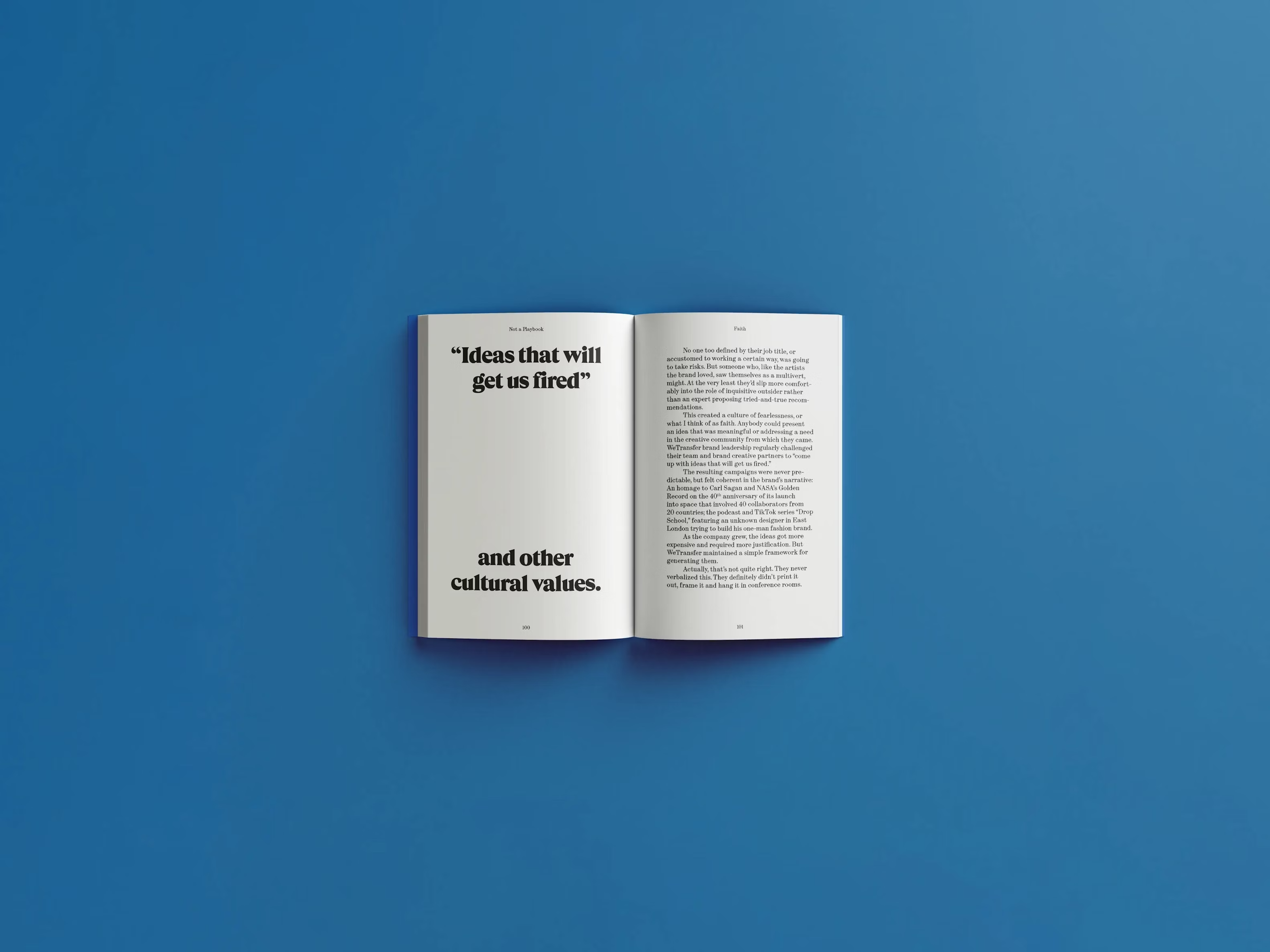
Damian Bradfield and Andreas Tzortzis: Not a Playbook (Copyright © Kris Pyda) Designed by Studio Pyda. Image from Notaplaybook.com.
I’ve seen this work in smaller organizations as well. Participatory processes seek user input; we listen, build with users, and then use the tools we created together. Creative trust becomes like a fountain of youth for the brand.
Flowers for Algorithms
The irony of writing about coherence is that the topic itself might be evidence of a problem. Did we collectively hallucinate a mid-aughts term, each of us probing the AI for a different take, only to land on the same one? If we all use the same algorithms to optimize our strategy, when will we realize we’ve metamorphosed into one giant, monocultured algae bloom?
But I have the antidote: you can tell when something was made by someone who cared. I think about this when I make collages. The elements clash. Different eras, different textures, things that shouldn't go together. The work is building something cohesive out of pieces that don’t match.
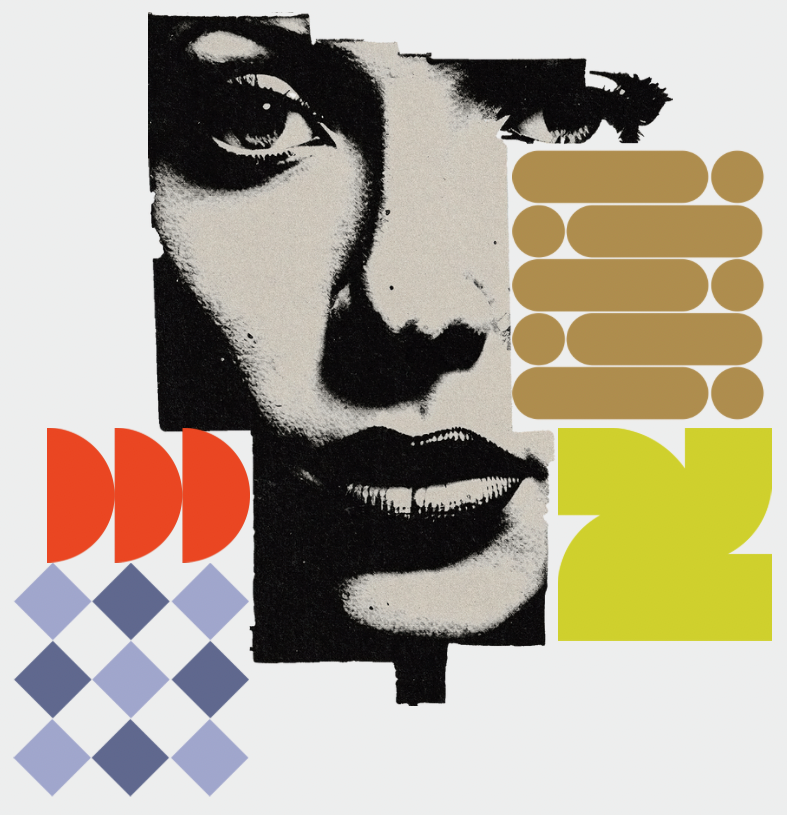
My personal art explores juxtaposition. I make digital collages, taking clashing elements and juxtaposing them within a single frame.
Choose Your Own Conclusion
In 2026, your customers don’t care if your hex codes match. Shoot, we’re probably all using the same shade of yellow by now.
Stop making everything match. Take the parts that clash, the parts that feel human and the parts that a human made, and build something more cohesive than the common AI frankenbrand.
Just do it.